Spare The Rod: Don’t Hit! (Part 2)

If the Old Testament of The Bible was written 6,000 years ago, then people who take it literally may be taking the word of God out of context. The meaning of words and concepts have changed drastically over the past 60 centuries, which leaves lots of room for misinterpretation.

Shoot the Ball!
For instance, take the example of a cowboy, a gunslinger from the Wild West. Put him on a basketball court, hand him a ball and tell him, “shoot the ball, shoot the ball!” What’s he going to do? He’s going to take the ball, drop it, and shoot it with his gun.

What you’re trying to tell him is to shoot the ball at the basket.

“The what?” He says.

“The hoop,” you tell him as you point to it.

“The who?” He replies.

Obviously his interpretation of your words is very different from what you meant. As the ball deflates you wonder, will anybody notice the bullet hole in the parquet floor?

The Question
When the Bible says not to spare the rod on a child, maybe it just means, “make certain you discipline your kids.”

Or, maybe hitting was the only form of discipline they had 6,000 years ago. If this was the case, then God might have simply been speaking to his people in terms they understood at the time.

For Another Theory…
…on why the rod is such a prevalent form of discipline in Proverbs, let’s take a look at the scribe who wrote down God’s word. Maybe his only form of known discipline was hitting. If he had the CRAP beat out of him as a kid, he’s going to filter the Word of God through his own life experience. What else is he going to say? “Give your kids a time out and use positive and negative consequences as an effective tool of discipline?”

NO! He had the crap beat out of him! He’s going to tell you to beat the crap out of your kids.

More to come on this subject soon. Until then, don’t hit!

And remember, you are not alone…

If you like this post, Stumble It!

Related Links:

– Spare The Rod: Don’t Hit (Part 1)
– Spare the Rod, Don’t Hit (Part 3)
– Never Hit a Child
– Equal Rights for Kids: Don’t Hit (Part 1)
– Equal Rights for Kids: Don’t Hit (Part 2)
– Equal Rights for Kids: Let Your Kids Decide

Spare the Rod: Don’t Hit!

I am far from an expert on the Bible, but over the past few weeks I’ve been learning quite a bit.

In Matthew 7:12 it says: “do unto others as you would have others do unto you.”

The question is: how is this being accomplished when we spank a child? Does anybody really want to be spanked? Yes I know, some people like to be spanked. Hey, some people like to roll around in broken glass (like Iggy Pop), but that doesn’t mean it’s a good punishment for our kids! I know I’d rather be spoken to about a problem than beaten over it.

I got to wondering, does the Bible really say that if I love my child, I need to “rod” him when he misbehaves? Does it REALLY say this?

So I did some research, and here’s what I found in the Old Testament:

“He who spares the rod hates his son. But he who loves him is diligent to discipline him.” — Proverbs, Chapter 13, Verse 24

“Folly is bound up in the heart of a child. But the rod of discipline drives it far from him.” — Proverbs, Chapter 22, verse 15

“Thou shalt beat him with the rod, and shall deliver his soul from hell.” — Proverbs, Chapter 23, verse 14

“Do not withhold discipline from a child. If you beat him with a rod, he will not die.” — Proverbs, Chapter 23, verse 13

This section of the Bible could have easily been called Corporal Punishment 101.

In A.J. Jacobs fantastic book, The Year of Living Biblically, he attempts to follow the “letter of the law” in Proverbs.

Unable to convince himself to buy an actual rod or paddle to discipline his son with, the author buys a “spongy Nerf bat.” On the surface it’s a comical moment, but if you dig a little deeper it’s not funny at all.

“After dinner he (his son Jasper) grabs a handful of nickels off the dresser and chucks them across the room. So I take the Nerf bat and smack Jasper’s butt with it. I’ve never spanked him before, despite several temptations to do otherwise. When I swing my bat, even though it’s spongy and harmless, I break some sort of barrier — I have now punished my son physically.

It’s an unsettling feeling. It drives home just how lopsided the relationship is. Parents have God-like physical dominance over their kids, at least when those kids have yet to reach puberty. Jasper seems undisturbed by all this. He responds by laughing hysterically, grabbing his wiffle bat, and attempting to smack me back.

So I’m basically sanctioning violence here. The rod is a fiasco. But here’s the thing, I agree with the gist of Proverbs. I need to discipline my son more. I need to give Jasper some tough love, dispense more timeouts, or risk having him turn into a three-foot tall monster…I’ve got to get stricter…”

I agree with Jacobs. It’s not about copping out of dispensing discipline, it’s about dispensing the best kind of discipline.

Jacobs’ problem is that he’s been incapable of following through on ANY form of discipline (not good for anybody involved). This is made obvious by the way his son reacts to being “struck” by the Nerf bat.

Jasper had no fear. Why? Because he fully trusts that his father has no intention to cause him hurt or pain. That’s a good thing. On the other hand, with no effective form of discipline Jasper has no respect for his father’s word. In turn, there’s never a realistic consequence for his actions, so he does what he wants. Not good.

Now exchange the Nerf bat with an actual rod, coupled with intent to “discipline,” and suddenly fear enters the picture. In this case, Jasper will probably stop the unwanted behavior because there’s a real consequence — but what has he learned?

The truth is, kids can be reasoned with. I’ve experienced it first hand. Zig Ziglar, one of my mentors, says, “people often act as you treat them.” Treat a child like they are capable of reasoning, of understanding, and they will be — especially if you nurture that.

Nurture them to a higher place. Not to a base level of fear. Stopping an action through fear does not teach virtue or ethical lessons. It teaches kids to distrust. Is that what you want for your kids? To go through life without real trust? What kind of relationships will they have with people? Their spouse and their kids? How will they perceive themselves?

In his book, A Little Book of Parenting SkillsMark Brady, PhD., explains:
“A parent’s role fulfills a sacred trust: one intended to safely help grow the heart, mind, brain and body of a vulnerable human being. No matter what you think, or what your own parents did that made you ‘turn out alright,’ hitting children violates that sacred trust.

Modern brain imaging studies clearly show that hitting children disrupts and disorganizes the developing structures of the body and brain. The home that used to be a safe refuge, no longer is. The people who used to be the ones a child could turn to for safety, no longer are. With nowhere safe to go, and no one available to turn to for soothing and help in regulating emotional distress, the world becomes an overwhelming, confusing, unmanageable place.”

My kids are two & four. They understand plenty good when I reason with them, or speak with them about the positive and negative consequences associated with their actions. The key, and the hard part, is keeping my word and following through with whatever consequence I dish out.

In Part 2 of this series I’ll consider the possibility that, if only taken literally, the Bible may be misinterpreted because the word of God is out of context. 6000 years have passed since the Old Testament was written. The meaning of words and concepts has changed drastically over 60 centuries.

And remember, you are not alone…

If you like this post, Stumble It!

Related Links:
Spare the Rod: Don’t Hit (Part 2)
Spare the Rod, Don’t Hit (Part 3)
Never Hit a Child
Equal Rights for Kids: Don’t Hit (Part 1)
Equal Rights for Kids: Don’t Hit (Part 2)
Equal Rights for Kids: Let Your Kids Decide
How You Pack a Grocery Bag is a Reflection of Who You Are

Grocery%20Bag-2How someone packs your groceries says a lot about who they are.
One day on the way home from work, I stopped at Super Target for some food. My check out experience was surprising for two reasons. (1) My bags were incredibly well packed; (2) I realized something insightful about people.

Before I go any further, I have to confess that I am a real stickler about how my bags are packed. I am very much like Mr. Monk about the whole thing (meats separate, frozen & cold stuff all together, etc). If you want to live, NEVER put Comet in with my milk, or a half-gallon of juice in the same bag as my eggs.

So, it’s no small feat that I was greatly pleased with how my cashier packed my bags. The most surprising thing of all was that I didn’t have to say a word. She just did it well.

I thanked her. Then I said, “you can tell a lot about a person by how they pack your groceries.”

Her response to my compliment was, “well, I just try to treat it like it were my own groceries, how I’d like them packed.”

What kind of a world would we live in if everybody was this conscientious about one another? If everybody were aware and thoughtful, even in situations that did not require it. My point is, this woman had integrity. It was part of who she was, and in my opinion her attitude could empower her to accomplish just about anything in life.

In my experience, many, many people (especially male grocery packers) do not take the time to put such care into what appears, at least on the surface, to be a mundane task.

How you pack a grocery bag is a reflection of who you are. It may sound ridiculous, but you either care or you don’t. You’re either mindful or you’re not. You either strive for greatness, or settle for mediocrity.

The good news is, no matter where you are on the “integrity scale,” you can improve.

This reminds me of the saying: treat others as you would like to be treated. It’s a simple, age-old concept, one that’s worth its weight in gold (just don’t pack it on top of my veggies).

And remember, you are not alone…

Great Local Business Story

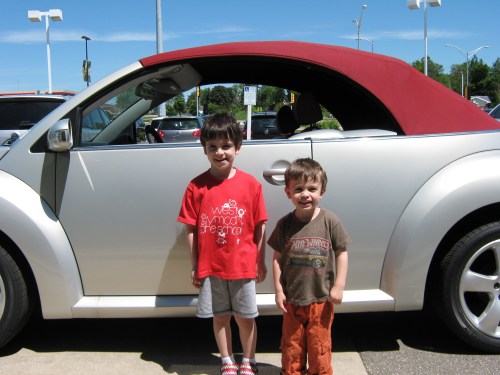
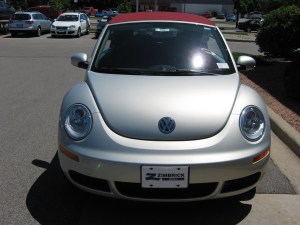
Today I took my family out to the local Volkswagen dealer here in Middleton, Wisconsin. The experience I had with the salesman, Michael Garski, was quite incredible.

IMG_0371
My boys, wife and I are all big Herbie the Love Bug fans, and we decided to go to the dealership to check out a Beetle, and hopefully take a test drive.

Michael was so gracious, and even though we told him we were just stopping by for a test drive, he treated us like family. It didn’t matter that we weren’t coming in ready to buy today. Michael was more concerned with providing outstanding service, building a relationship and honoring the philosiphy of his dealershihp (which is Zimbrick Volkswagen, on Century Avenue by the way).

IMG_0375

My kids were given a brochure about the Beetle, as well as a few promotional DVD’s about Volkswagen cars. We were made to feel special and welcome, and I actually felt guilty leaving without making a purchase. When we’re ready, I know who my salesman will be when we purchase a Volkswagen Beetle (possibly two when my boys are old enough to drive).

Mike is the grandfather of two grand daughters, only 11-months apart. I could tell how much he enjoys and misses them by the way he treated my kids. Thank you Michael!

And remember, you are not alone…

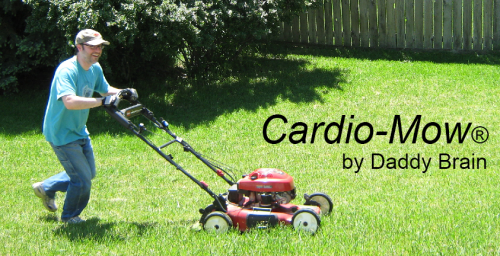
The Latest Exercise Craze: The Cardio Mow

Picture 1

For decades, people have been complaining about not having enough time to exercise. And when spring time rolls around, it gets even worse. Yard work starts to take up some of our precious weekend time.

Since you’ve become a dad, you’ve already given up naps, showers and sex — so what’s an aging guy with a growing pot-belly to do?

Fear not, all your problems are solved with…

The Cardio Mow!

Yes, that’s right, now you can combine a healthy cardiovascular workout with your weekend mowing, with the Toro variable speed push mower (estimated top speed is 5 mph).

Trim off those extra pounds as you trim your grass!

If you enjoy sweating profusely and having all kinds of insects stick to your body, then this is the perfect exercise for you. Plus the exciting feeling of seeing just how many dandelion weeds have turned into those spikey, deadly looking mutations can not be matched by traditional forms of working out.

And you thought sleep deprivation was exciting and rewarding.

And remember, you are not alone…

If you like this post, Stumble It!

The Daddy Brain Book Guide: Resources & Reccomendations


Picture 7

This resource guide is designed for both dads and moms. As I put together the list, I realized that most of my sources were not “parenting books.” Rather, they’re books and audio books (perfect for people with long commutes) about all facets of life that have either affirmed or influenced me — as a parent, a husband and a spiritual being. Some help me develop philosophies on how to treat my children, while others enlighten me about what to teach them. Everything is linked to Amazon, so you can learn more about each book… 

PARENTING
Books by Dr. Mark Brady, PhD:
– A Little Book of Parenting Skills
– Right Listening (formerly A Father’s Book of Listening)
– The 40-Year-Old Version: Humoirs of a Divorced Dad,
by Joel Schwartzberg

– – – –

SPIRITUALITY
– Conversations with God, by Neil Donald Walsch
– Good Book, by David Plotz
– Spirit Healing: How to Make Your Life Work, by Mary Dean Atwood
– Eagle Vision: Return of the Hoop, by Ed McGaa, Eagle Man
– The Year of Living Biblically, by A.J. Jacobs
(I highly recommend the unabridged audio book)
– Zen and the Art of Poker, by Larry W. Phillips
(you must understand the game of poker to get the most from this book)
– Zen in the Art of Climbing Mountains, by Neville Shulman
(no mountain climbing experience necessary)

– – – –  

INSPIRATION, MOTIVATION, GOALS
– Tribes, by Seth Godin
– Zen in the Art of Climbing Mountains, by Neville Shulman
– Who Moved My Cheese? by Spencer Johnson, M.D. 

Books and Audio Books by Zig Ziglar:

Books
– See You at The Top (definitely read this one first)
– Over The Top
– Zig: The Autobiography of Zig Ziglar

Audio Books
– Goals
– Success and the Self Image
– A View From The Top
– How to be a Winner

– – – –  

SELF IMPROVEMENT
(Note: all of Zig Ziglar’s books fall under this category as well)

Books
– The Sedona Method, by Hale Dwoskin

Audio Books
– The Sedona Method,
 by Hale Dwoskin
(The CD’s are expensive, but they can also be life changing) 

– – – –  

THE HUMAN BRAIN, AND OTHER INTERESTING STUFF
– How We Decide, by Jonah Lehrer

Books & audio books by Malcolm Gladwell:
(Highly recommended in audio book form, Malcolm is an excellent reader)
– The Tipping Point
– Blink
– Outliers

– – – –  

AWESOME KIDS’ BOOKS
– Hugo Cabret, by Brian Selznick
– Some Dogs Do, by Jez Alborough
– The Carrot Seed, by Ruth Krauss, Crockett Johnson
– The Little Prince, by Antoine de Saint-Exupery


Goals & Emotions

Goals are important.

Short-term or long-term, they have the ability to define who we are and what we do in our life (as long as we do our part to attain them).

I sure have plenty to work on, and with a 45-minute commute each way to and from work I have ample opportunity to listen to audio books on a variety of topics.

Lately, my CD player has been spinning tracks on leadership, inspiration, motivation and goals.

Although they’re very helpful, there is one aspect of the puzzle that’s missing — emotions.

The question is: how do we clarify our goals, let alone take steps to reach them, if our daily existence feels like such a struggle to survive?

Sure, there are some fantastic ideas on these CDs, many of which I use on a daily basis. Speakers like Zig Ziglar and Brian Tracy really believe that each day can be chock-full of productive, goal-reaching actions. And they’re right.

But what about when we’re not feeling right?

I’m not talking about a bad attitude here, I’m talking about depression, exhaustion, anger or an upsetting matter that is weighing heavily on our minds — whether it’s a bad work environment, a sick family member or a personal illness — these are all issues that need addressing. They’re also issues that can very easily become obstacles to setting and acheiving goals.

Sometimes our day is full of coping. Whether it’s chatting with co-workers, surfing the Web, TV or some other distraction to get ourselves through the day (and night). So you could say that the immediate goal is to hold oneself together and survive, plain and simple.

Finally, the day ends. But will your sleep be peaceful? Will you wake up the next day feeling any different? Maybe, if your “problem” was a small matter that needed a day or two for you to let it go. But if the problem still exists, this routine can lead deeper and deeper into feelings of hopelessness.

Not good. It’s also not true — it’s just a feeling (albeit an extremely strong, oppressive one).

Like John Lennon said, “where there’s life, there’s hope.” I believe he’s right. I’ve experienced it. From almost dying of Crohn’s disease, to not being able to find a job, to ectopic pregnancies, I have faced situations that seemed unsolvable. But I was given hope by my lovely wife, and I am eternally grateful.

I know first hand that sometimes making it through the day is such a large goal, it feels like it’s all we can do.

But it’s not.

We have choices. The first of which is getting some positive thoughts into our heads to help us find some hope. Hope will lead to inspiration & motivation (that’s where these fantastic writers, speakers and loved ones come into play), which has the power to carry you out of just about any situation.

Second, if you need help, get help. Whether it’s depression, addiction, illness — whatever is bringing you down — get the help you need. Your life depends on it. Sometimes literally.

Just like I spoke about replacing bad habits with good ones in, The Four H’s of Self Destruction: When Hobby Becomes Habit, we need to do the same thing here. We need to replace a neutral or negative way of coping with a positive one.

Instead of taking 10 minutes to check Facebook or Twitter (which we just checked 20 minutes ago), or to kill time until 5 O’clock arrives, we can make a phone call to a specific person or organization that has the potential to help us move forward. Or we could read a few pages of a book that’s geared towards one of our goals.

If we don’t know exactly who to call or what to read, we can take that time to make a list or search the Web for resources. You get the idea. We’re still giving ourselves a chance to cope, but this option offers significant benefit, at the very least helping  us feel better about ourselves. I’m not encouraging you to avoid doing your work at work. But the law says you get a lunch hour. How you use it is up to you.

In my case, I started with small, manageable steps and then began to determine and place some of my long-term goals alongside this survival goal. When we do this, we move from surviving toward thriving.

Would you rather survive as a troubled person or survive as a triumphant one? I truly believe that if you make enough positive life changes, no matter how small, they will add up. Your life and your attitude will improve.

If we substitute real, focused goals for “water-cooler chit-chat,” then we’re really doing something about the current situation as well as our future. In other words, we can choose to kill time or use it to build a life.

Either way the time will pass, and we’ll accomplish exactly what we set out to do.

(Note: This blog is in no way meant to replace or substitute the help of a professional. I am not a doctor. Although I hope this article proves helpful, I do not have all the answers. But I do have lots of questions…)

And remember, you are not alone…

If you like this post,Stumble It!

I Need a Break! (but will it help me?)

I want a break. And I deserve a break.

But if I always take a break, I’ll never get a break from the thing I need a break from.

The break is short term, and changes nothing (if we’re lucky, it does help us feel more relaxed). After the break, I often feel the same as I did before I took it. Only now time has passed, so that gets me even more upset because I’ve “wasted” the little time I have to make a difference.

Taking that time to make changes has the potential to give me a permanent break from what I need a break from.

This may sound absurd, or like a line from a Gertrude Stein novel, but it’s true.

And remember, you are not alone…

If you like this post, Stumble It!

The Four H’s of Self Destruction: When Hobby becomes Habit

Hobby

Oxford American Dictionary

In this installment of The Four H’s of Self Destruction, we’ll take a closer look at some of the factors that turn Hobby into Habit. If you’d like to read the first part of the series click here.

I’ve been investigating this topic for months. Although I’ve learned a lot, I have discovered that each new bit of information I uncover holds more questions than it does answers.

What is the tipping point where Hobby becomes Habit?
Let’s begin with a comparison of meaning between the two:

Hobby: “done regularly in one’s leisure time for pleasure” (harmless).
Habit: “a regular tendency or practice, especially one that is hard to give up / informal: an addictive practice, especially one of taking drugs, which can develop into a bad habit” (not so harmless).

According to my mentor, Zig Ziglar:
“Good habits are difficult to acquire, but easy to live with. Bad habits are easy to acquire, but difficult to live with. Almost without exception, bad habits come slowly and pleasantly and, in most instances, the habit has you before you’re aware you have the habit.

Habit is a cable. We weave a thread of it each day until it becomes too strong to break. Then the strength of that habit cable takes us to the top – or ties us to the bottom, depending on whether it is a good habit or a bad one… All bad habits, trends, etc., start slowly, quietly and apparently harmlessly.”

It’s important to remember, not all habits are negative. In fact, some can be very positive. It’s a good habit to brush your teeth, eat three meals a day, exercise and shower regularly. Brushing your teeth becomes a bad habit when you’re doing it so much that you’re causing your mouth to bleed, or it’s interfering with your day because you’re physically, mentally and/or emotionally held hostage by the habit.

Habit appears to be linked to addiction, obsession, compulsion and dependence – and I wonder which comes first – the habit or the mental state. When something is a hobby, does one obsess over it until it turns into a habit (addiction)? Or does something become a habit first, and then one starts to obsess over it?

In other words, does a person with a habit develop obsessive/compulsive tendencies, or is someone with an obsessive/compulsive personality simply manifesting their mental state into reality in the form of a habit?

I also think that hobbies can become bad habits when we start using the hobby as a coping mechanism. If we’re using it to cope, then it takes on attributes that are designed to help us AVOID solving problems. I’m not talking about coping for a short period of time because of a major life event. I’m talking about using it on a daily basis under “normal circumstances.”

A person may sit down “to relax” and watch some TV instead of sitting down at the computer to update their resume and make a game plan to find a better job. The habit of watching TV is rationalized into a solution, but in reality only perpetuates the problem. Weeks, months and years may go by without any change in the resume, let alone one’s place of employment. Unless, of course, this person does indeed get on the computer after they’ve watched their show. In which case, the TV has not be come a negative habit, but is being used simply to relax before they get down to work.

Substitute a TV habit with any of the infinite other things that people find comfort in, and you’ve got a whole lot of people stuck in a habit of procrastination, among other things.

How do we procure a hobby into a good habit and keep it there?
Where is the in-between point where the habit is healthy and effective? It’s important to distinguish bad habits from good, and define the line that exists where fantastic turns to fatal because you’ve gone too far. I think it’s a question of dedication (which includes motivation, inspiration, determination and hope) vs. addiction (which includes dependency, obsession, compulsion and enslavement).

In Seth Godin’s book, Purple Cow, he mentions the Japanese word Otaku, which means “something that’s more than a hobby but a little less than an obsession. Otaku is the overwhelming desire that gets someone to drive across town to try a new ramen-noodle shop that got a great review. Otaku is the desire to find out everything about Lionel’s new digital locomotive – and tell your fellow hobbyists about it.”

Otaku is a place that seems positive. It’s got desire and determination built into it, without any negative baggage.

How do we get rid of a bad habit?
I need to start off by stating that I am not a psychologist or a doctor. Although I’d like to share my findings on the subject, this article is not meant to replace the help of a professional. But I do hope you find it helpful, or at least as interesting as I do.

In William James’ book, Psychology, published in 1948, James writes of “the two great maxims of treatment,” develoved by Professor Alexander Bain:

“The first is that in the acquisition of a new habit, or leaving off of an old one, we must take care to launch ourselves with as strong and decided an initiative as possible. Accumulate all the possible circumstances which shall re-enforce the right motives; put yourself assiduously in conditions that encourage the new way; make engagements incompatible with the old; take public pledge, if the case allows; in short, envelop your resolution with every aid you know. This will give your new beginning a such a momentum that the temptation to break down will not occur as soon as it otherwise might; and every day during which a breakdown is postponed adds to the chances of its not occurring at all. 

The second maxim is: Never suffer an exception to occur till the new habit is securely rooted in your life. Each lapse is like the letting fall of a ball of string which one is carefully winding up; a single slip undoes more than a great many turns will wind again. Continuity of training is the great means of making the nervous system act infallibly right.”

Zig Ziglar speaks similarly on the subject. He mentions that to break a bad habit, first one must truly commit to breaking it. Then a person needs to avoid the unwanted habit for at least 21 days in order to “break” it. He also mentions that you cannot discard an old habit without replacing it. In other words, you’ve got to find a new, positive habit to fill the void left when you let go of the old one.

The next installment of the series looks at what happens when Habit becomes Harmful.

And remember, you are not alone…  

If you like this post, Stumble It!